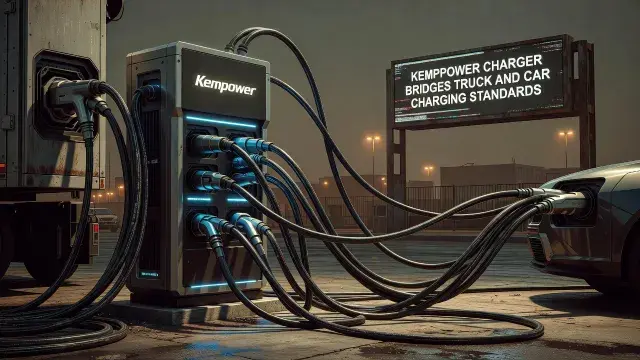
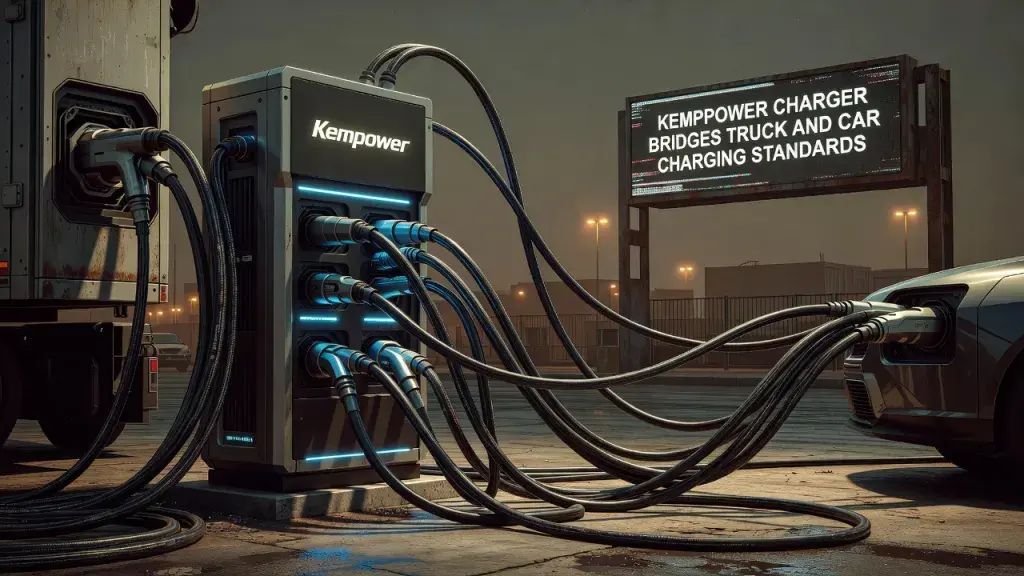
A single charging cabinet that can serve both a passenger car and a heavy-duty truck, without operators building two separate systems, is now commercially real. Kempower unveiled its Mega Satellite Flex this week at ACT Expo during the company's Unplug & Recharge event, introducing a charger that supports the established CCS standard at up to 560 kW alongside the emerging Megawatt Charging System (MCS) at up to 1.2 MW. It is the Finnish manufacturer's first dispenser built to handle either standard, a design choice aimed squarely at the awkward transition period the charging industry now finds itself in.
That transition is the real story here. CCS has been the workhorse connector for electric cars and light commercial vehicles for years, but it was never engineered for the power demands of long-haul electric trucks, which need to recharge huge battery packs in the time a driver takes for a mandated rest break. MCS was developed specifically to close that gap, and infrastructure built around it is only beginning to appear across North America and Europe. Operators planning charging sites today are effectively making a bet on which vehicles will show up tomorrow - cars, trucks, or both - and Kempower's answer is to let a single unit hedge that bet. Fleet managers researching the rollout can already download the app that Kempower uses to monitor and manage its charging network remotely, a detail that underscores how software, not just hardware, now defines competitive positioning in this space. download the app
Technically, the Mega Satellite Flex is built for the upper end of both worlds. It handles up to 1,500 amps for MCS sessions and 700 amps for CCS, with a 5-meter cable for CCS vehicles and a shorter 2.7-meter cable for the more compact MCS connector. An optional payment terminal allows the unit to serve as a public-facing dispenser rather than a fleet-only asset. Just as significant is its compatibility with newer 800-volt vehicle architectures, which are becoming more common in both passenger and commercial segments because they permit faster charging without the thermal and cabling penalties associated with older 400-volt systems.
Why Shared Infrastructure Matters for Operators
Charging site economics depend heavily on utilization: a dispenser sitting idle for hours between sessions is a poor investment regardless of its peak power rating. By serving both CCS passenger and light-commercial traffic and MCS heavy-duty traffic from the same hardware, operators can theoretically keep utilization higher from the moment a site opens, rather than waiting years for truck traffic to justify a dedicated MCS buildout. Kempower is also emphasizing that the Mega Satellite Flex plugs into its existing distributed charging architecture, meaning operators who already run Kempower systems do not need to rip out infrastructure to add megawatt capability later.
What Comes Next
The Mega Satellite Flex is scheduled to reach the North American and European markets in July 2026, giving fleet operators, truck stop developers, and public charging networks a runway to plan deployments around it. Whether MCS becomes the durable standard for electric trucking, the way CCS did for passenger vehicles, remains an open question the industry will settle over the next several years. Hardware that hedges against that uncertainty, rather than committing to one outcome, is likely to become more common as the market decides.