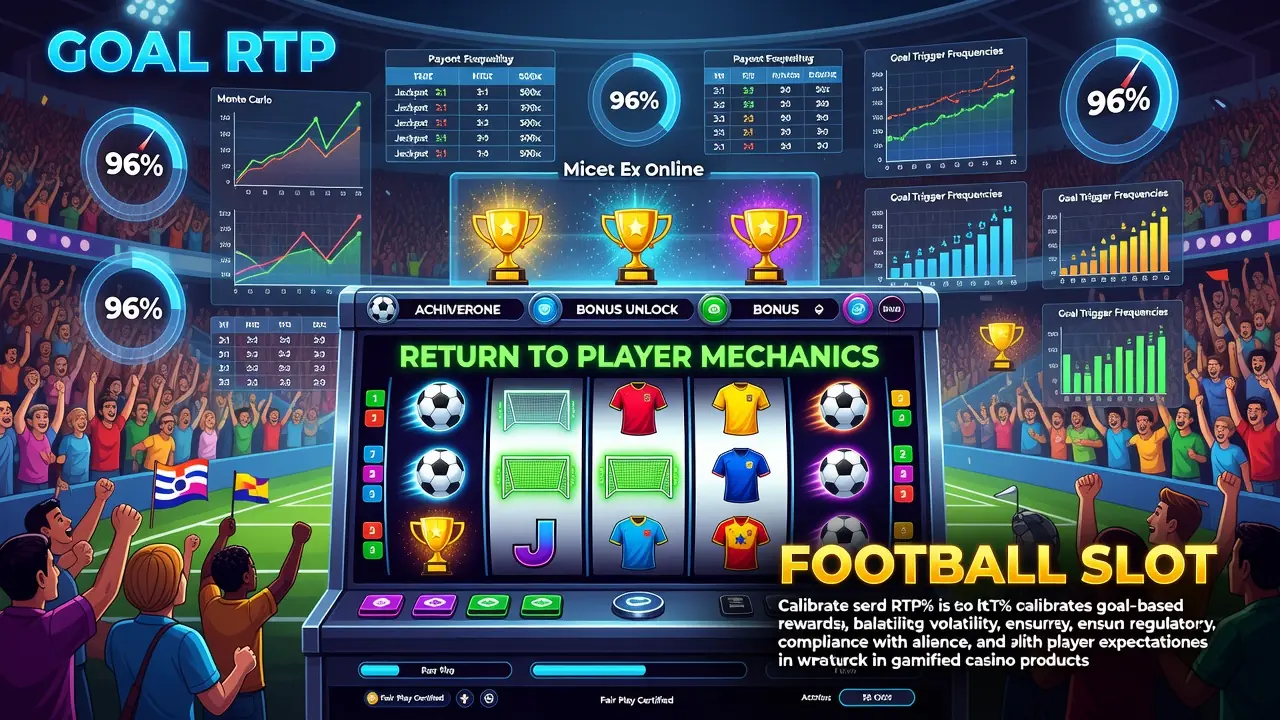
A single percentage point on a payout table can shift millions of dollars in player winnings over a year of gameplay. That is the reality behind return to player mechanics, and it becomes even sharper when a game rewards players for hitting specific in-game objectives rather than just spinning reels or dealing cards. Goal RTP is the mechanism that governs how much of a player's wagered money comes back to them specifically through goal-based rewards - scoring, achievements, milestone triggers, bonus unlocks tied to completing a task within the game.
Developers who build goal-oriented mechanics into slots, sports-themed titles, or gamified casino products face a distinct challenge. Standard RTP models spread payout probability across every spin or hand. Goal-based systems instead concentrate value around achievement points, which means the math behind them needs separate calibration. A title like goal rtp demonstrates how a football-themed slot can tie payout events directly to in-game goals, turning a simple scoring animation into a genuine return mechanism. Getting that calibration wrong either drains operator margins or drives players away from a game that feels stingy.
This piece breaks down what goal return to player actually measures, how operators and designers calculate it, and what practical steps go into setting an RTP percentage for goals that satisfies both business requirements and player expectations. The aim is a working knowledge of the topic, not marketing language about fairness or excitement.
What Goal RTP Really Means in Online Gaming
Goal RTP refers to the portion of total wagers returned to players through rewards linked to a defined in-game objective - scoring a goal in a football-themed slot, completing a quest tier, or triggering a bonus round after a sequence of qualifying events. It is a subset of overall game RTP, isolated to measure the specific payout channel tied to that achievement.
The Difference Between Standard RTP and Goal-Based RTP
Standard RTP averages payout across every wager placed, regardless of how the win occurred. Goal-based RTP isolates one payout stream - the goal event - and measures return generated exclusively through that trigger. A game can carry an overall RTP of 96% while its goal-specific contribution sits anywhere from a fraction of a percent to a substantial share, depending on how frequently the goal event fires and how large its associated payout is.
Why Goal Mechanics Changed RTP Calculations
Traditional slot math assumed uniform probability across symbols and paylines. Goal mechanics introduced conditional payout logic: a reward only fires after a qualifying sequence completes. This forced designers to build layered probability models where the goal event's frequency and payout size both need independent tuning, rather than relying on a single combined paytable.
Where Players Encounter Goal RTP
Football and sports-themed slots are the most visible examples, but the same logic appears in quest-based casino apps, tournament ladders, and gamified loyalty programs where completing a defined action unlocks a cash or credit reward.
How Goal Return to Player Is Calculated
Calculating goal return to player starts with isolating the payout events tied to the objective and running them against total wager volume over a statistically significant sample. Because goal events are conditional - they only occur under specific game states - the calculation requires simulation across millions of rounds rather than simple arithmetic on a paytable.
The Core Formula and Its Variables
At its base, goal RTP equals total payouts generated through goal events divided by total wagers placed, expressed as a percentage. The variables that shift this number include goal trigger frequency, payout multiplier size at the moment of the goal, and any scaling rules that increase reward value based on player progress or stake level.
Simulation Models and Statistical Sampling
Designers run Monte Carlo simulations spanning millions of virtual rounds to confirm that the theoretical goal RTP converges with the intended target. Small sample sizes produce misleading volatility; only large-scale simulation reveals whether the goal mechanic behaves as designed across realistic play patterns.
Common Calculation Errors
- Treating goal frequency as fixed when it actually varies with player skill or bet size
- Ignoring correlation between goal triggers and other bonus features that share the same probability pool
- Underestimating variance in short sessions, leading to a mismatch between theoretical and observed return
RTP Percentage for Goals: Setting the Right Target
Choosing the right rtp percentage for goals is a balancing act between regulatory limits, competitive positioning, and the game's overall volatility profile. There is no universal number that works for every title; the target depends on how goal frequency interacts with base game payout and how the operator wants the goal mechanic to feel to players.
Regulatory Floors and Ceilings
Most licensing jurisdictions set minimum RTP thresholds for the overall game, commonly in the 85-96% range depending on the market. The goal-specific portion must fit within that overall budget without pushing the combined RTP below the legal floor or above what the operator's margin structure can sustain.
Balancing Goal Frequency Against Payout Size
A goal event that fires often but pays modestly produces a very different player experience than one that fires rarely but pays generously, even if both contribute the same rtp percentage for goals to the total return. Frequent, smaller triggers create steady engagement; rare, larger triggers create anticipation and spikes in session excitement. Designers pick between these profiles based on the target audience's risk appetite.
Aligning Goal RTP With Overall Game Volatility
A high-volatility base game paired with a low-volatility goal mechanic can feel disjointed to players. Consistency between the two systems keeps the pacing of wins predictable enough that players form accurate expectations about how the game behaves over a session.
Strategies to Optimize Goal RTP Settings
Once the target percentage is set, the practical work of tuning begins. Optimizing goal RTP settings means adjusting trigger conditions, payout tables, and progression curves until the simulated return matches the design intent while keeping the game commercially viable.
Adjusting Trigger Frequency Without Distorting Player Perception
Small changes in trigger probability produce outsized effects on perceived fairness. Reducing goal frequency by even a modest margin can make a game feel colder to returning players, even if the payout size compensates mathematically. Testing perception alongside math matters as much as the raw numbers.
Dynamic Scaling Based on Stake Size
Some systems scale goal payouts proportionally to bet size, which keeps the goal return to player consistent across stake tiers. This avoids a situation where high rollers experience a diluted return simply because the goal payout was calibrated around a lower default bet.
A/B Testing Goal Mechanics Before Full Deployment
Running parallel versions of a game with slightly different goal RTP configurations against segmented player groups reveals which setting produces better retention without sacrificing margin. This testing phase catches problems that pure simulation misses, particularly around session length and perceived pacing.
Iterating After Launch
Live data almost always surfaces gaps between simulated and actual player behavior. Operators who revisit their goal RTP configuration after a few months of real traffic, rather than treating the launch settings as final, tend to sustain better long-term engagement.
Online Gaming Goal RTP: Market Trends and Player Expectations
Players have grown more attentive to payout mechanics generally, and goal-based systems are no exception. Online gaming goal rtp transparency has become a differentiator, with informed players actively seeking titles that publish clear breakdowns of how goal payouts contribute to overall return.
Rising Player Literacy About RTP Mechanics
Forums, review sites, and community discussions have pushed baseline RTP literacy higher than it was a decade ago. Players increasingly ask not just what a game's overall RTP is, but how that return is distributed across different payout channels, including goal events.
Competitive Pressure Among Operators
As more studios build goal-themed titles, operators face pressure to publish or at least clearly signal their goal RTP structures. Titles that hide unfavorable goal mechanics behind an attractive headline RTP figure risk reputational damage once players compare notes.
Mobile Play and Session Length Effects
Shorter mobile sessions change how goal frequency should be tuned. A goal mechanic designed for long desktop sessions may underperform on mobile if players rarely play long enough to reach the trigger threshold, which pushes designers toward more frequent, smaller goal events for mobile-first audiences.
Practical Steps for Operators and Designers
Turning the theory above into a working product requires a sequence of concrete steps, from initial modeling through post-launch monitoring.
Building the Initial Probability Model
Start with a clear target for the overall game RTP, then allocate a defined share to the goal mechanic based on how central that feature is to the game's identity. A football slot where scoring is the headline feature should allocate a larger share to goal RTP than a game where the goal event is a secondary bonus.
Compliance Review Before Launch
Every jurisdiction where the game will run needs a compliance check confirming that the combined RTP, including the goal-specific portion, satisfies local licensing requirements. This step should happen before final art and animation work, since late-stage math changes are costly.
Post-Launch Monitoring and Adjustment
- Track actual goal trigger frequency against simulated projections weekly during the first quarter after launch
- Monitor player complaints or forum feedback specifically mentioning the goal mechanic
- Compare retention metrics between players who frequently reach goal events and those who rarely do
Frequently Asked Questions
What counts as a good rtp percentage for goals in a typical online slot?
There is no fixed universal figure, but goal-specific contributions commonly represent a modest slice of the overall RTP budget, often somewhere between one and a few percentage points depending on how central the goal mechanic is to the game. A game built around scoring as its main feature will allocate a larger share to that channel than one using goals as a minor bonus trigger.
Does a higher goal RTP always mean better player experience?
Not necessarily. A higher goal RTP paired with very infrequent triggers can feel worse to players than a lower goal RTP delivered through frequent, smaller rewards, because perceived fairness depends heavily on trigger frequency and session pacing, not just the raw percentage.
How often should operators revisit their goal RTP settings after launch?
A review after the first few months of live data is standard practice, since real player behavior often diverges from simulation assumptions. After that initial adjustment, periodic reviews every six to twelve months help catch drift as player demographics or play patterns shift.
Can goal RTP be adjusted without affecting the base game's paytable?
Yes, in most well-designed systems the goal mechanic runs on its own probability layer, separate from base game symbols or paylines, which allows designers to tune goal frequency and payout size independently. This separation is exactly what makes isolated goal RTP calculation possible in the first place.
Why do mobile and desktop versions of the same game sometimes show different goal RTP behavior?
Session length differs sharply between platforms, and goal mechanics calibrated for long play sessions may rarely trigger during short mobile sessions. Designers often adjust trigger frequency per platform to keep the effective return consistent regardless of where the game is played.
How do regulators verify that a stated goal RTP is accurate?
Independent testing labs run large-scale simulations against the game's actual code to confirm that theoretical RTP figures, including goal-specific contributions, match what the software actually produces. This verification happens before certification and periodically afterward as part of ongoing compliance audits.